
EPDM vs GRP vs felt: which flat roof is right for you?
November 18, 2026
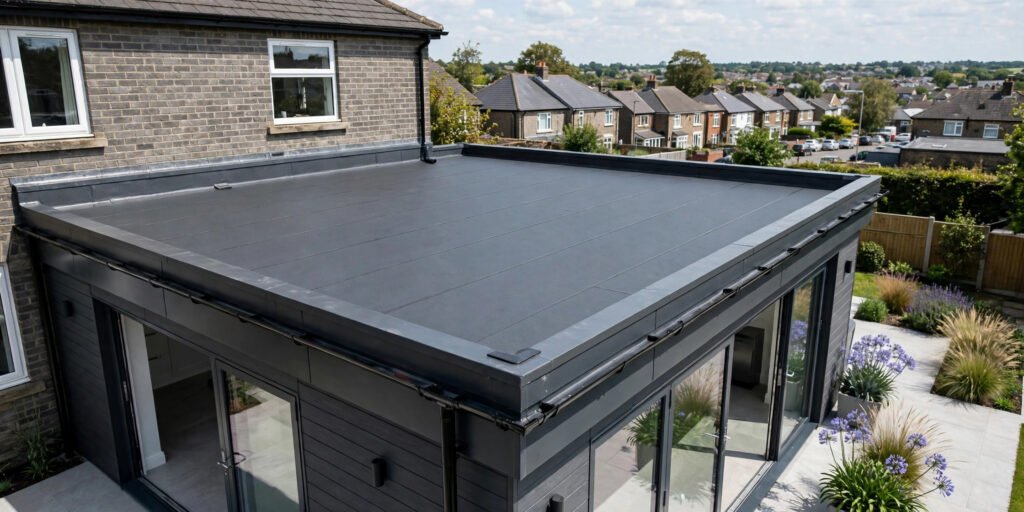
If you need a new flat roof in Plymouth, you will quickly come across three names: EPDM, GRP, and felt. They are the three systems we install, and each one is a genuine option — there is no single best choice, only the best choice for your particular roof. This guide explains what each one is, what it is good at, and what to think about before you decide. The final decision is made at the survey, when we can see your roof.
EPDM rubber — the single-piece roof
EPDM is a synthetic rubber membrane, fitted as a single piece with no joins. That is its biggest strength. Flat roofs fail at the joins, the edges, and the outlets, so a system with no joins in the main covering takes a whole category of problems out of the picture. The membrane is laid over the deck, bonded down, and finished with trims at the edges and outlets.
EPDM suits straightforward flat roofs particularly well — garage roofs, extension roofs, and dormer roofs where the shape is simple and the covering can be laid in one piece. It is flexible, so it copes with the small movements that happen as a building warms up and cools down, and it stands up well to Plymouth’s rain and salt air. Our flat roof systems carry up to 25-year material guarantees on the systems we install.
One thing to know: EPDM is a membrane, not a hard shell, so it can be punctured if something sharp is dropped on it, and it needs the right trims and flashings at the edges to do its job. That is why the detailing matters as much as the membrane itself.
GRP fibreglass — the hard, seamless finish
GRP stands for glass-reinforced plastic, and it is better known as fibreglass. It is applied as a liquid resin with a glass fibre mat, and it cures into a hard, seamless shell over the roof. Like EPDM, it has no joins in the main covering, and once it is cured it is tough, rigid, and fully waterproof.
GRP is often the right choice where the roof gets walked on — a balcony, a terrace, a roof over a living space that needs regular access, or a flat roof with plant or equipment on it. The hard finish stands up to foot traffic in a way a rubber membrane does not.
GRP needs the right conditions to cure properly, and it needs an experienced fitter — the resin has to be mixed and laid correctly, and the detailing at the edges has to be done with the same care as the main surface. It is a rigid system, so the deck underneath has to be sound and stable — if the deck is soft or moving, that has to be fixed first.
Felt — the traditional system
Felt flat roofs have been around for decades, and they are still a solid option. Modern felt systems are a long way from the old single-layer roofs that used to blister and crack. Today’s torch-on and cold-applied felt systems are laid in layers, bonded together, with a mineral finish on top, and they give a reliable, proven covering for many straightforward flat roofs.
Felt suits roofs where the budget is tighter and the roof is a simple shape with good access. It is straightforward to repair if it is ever damaged, and it does the job on garages, extensions, and outbuildings across Plymouth, Devon, and Cornwall. It does have joins, because it is laid in rolls, and the joins are where a felt roof needs its installer to be careful — but a properly laid felt roof, with its laps sealed and its edges finished, will keep the rain out for years.
Felt is also the system we most often see on older flat roofs that need replacing, so if your current roof is felt and it has served you well, replacing it with a modern felt system is a perfectly reasonable choice. If you want fewer joins and a longer-lasting covering, EPDM or GRP may be worth considering instead.
So which one is right for you?
It depends on your roof. A simple garage roof that nobody walks on is a different job from a balcony roof over a living room, and a roof with lots of corners and upstands is different again. The shape of the roof, how it is used, what is underneath it, and how long you want it to last all feed into the decision.
That is why we survey first. We visit, climb up, look properly, and explain what we find — no pressure, no jargon. Then you get a written, itemised, fixed-price quotation with no obligation, setting out the system we recommend and why. If your flat roof is leaking or ponding, we will also tell you honestly whether a repair is enough, because a new roof is not always the answer.
What to do next
If you have a flat roof in Plymouth, Devon, or Cornwall that needs attention, call us on 07347 634501, message us on WhatsApp, or fill in the quote form. We offer 24/7 emergency call-outs, and every job starts with a free survey and a written quote. Sky Roofing (SW) Ltd — 21+ years’ experience, 4.8 stars from 43 Google reviews.