
7 signs your roof needs a repair (before it leaks)
November 18, 2026
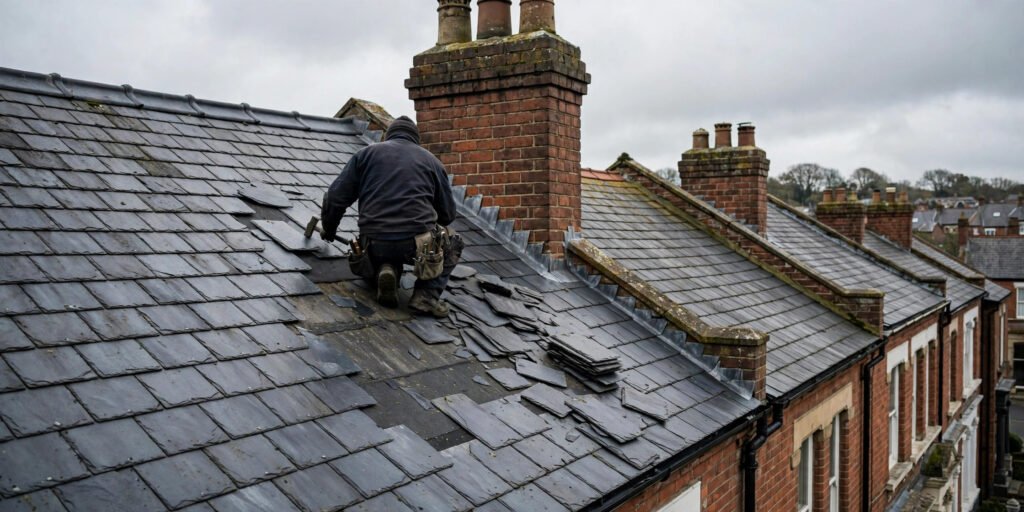
Most roof problems start small. A slipped slate, a cracked flashing, a blocked gutter — none of them look serious from the pavement. But roofs do not fix themselves, and a small problem left alone usually becomes a bigger, more expensive one. Your roof gives you warnings long before water comes through the ceiling. Here are seven signs to look out for.
1. Slipped, cracked, or missing tiles and slates
This is the most obvious sign, and the easiest to spot. Stand across the street and look. Are any tiles or slates out of line, cracked, or missing altogether? A slipped slate leaves a gap where rain gets straight in. On older slate roofs, slipped slates are often caused by tired battens or fixings that have rusted away. A single slipped slate is a quick repair. Slates slipping in several places need a proper look, because the problem is usually underneath the covering, not on top of it.
2. Moss, lichen, and algae growing on the roof
A bit of green on a north-facing roof is common where the air is damp. But thick moss is more than a cosmetic problem. Moss holds water against the tiles and slates, and in winter that water freezes, expands, and lifts the edges of the covering. Moss also washes down into the gutters and blocks them. If your roof is green and shaggy, it needs attention. Our soft-wash roof cleaning removes moss, lichen, and algae without pressure washing, which can damage tiles and slates — and the gutters are cleared at the same time.
3. Damaged or split flashing
Flashing is the metal — usually lead — that seals the joints where your roof meets a chimney, a wall, a valley, or a dormer. It is a common place for leaks, and hard to see from the ground. If flashing has lifted, split, or come away from the wall, water is getting in behind it. Lead splits with age as it expands and contracts, and the mortar holding it weathers away over time. We check flashings at every survey — a leak is often a flashing problem, not a tile problem.
4. Gutters overflowing, sagging, or full of plants
Your gutters are part of your roof, and they tell you a lot about its condition. If water pours over the edge every time it rains, the gutter is blocked, the fall is wrong, or the outlet is choked. If a section is sagging or pulling away from the fascia, the brackets have failed or the fascia board behind it has rotted. And if you can see plants growing in the gutter, it has been full of wet debris for a long time. Blocked gutters let water run down your walls and into your home, and they rot the fascia and soffits they are fixed to. We offer vacuum gutter cleaning, annual maintenance contracts, and full replacement in long-life UPVC or seamless aluminium, plus anti-leaf gutter guards.
5. Damp stains on ceilings or walls
A brown stain on a bedroom ceiling, a damp patch, or paint bubbling and peeling — these are the signs most people notice first, and by the time they appear, water has already been getting in for a while. The leak is rarely directly above the stain — water runs along battens and joists before it drips through. Do not just paint over a damp stain. It will come back, and the timber underneath will keep getting wetter. If you see a stain, call us. We offer 24/7 emergency call-outs across Plymouth, Devon, and Cornwall, and we will find where the water is actually getting in.
6. Daylight or draughts in the loft
Go up into the loft on a bright day and turn the light off. If you can see daylight coming through the roof, there is a gap in the covering — a missing slate, a hole in the felt, or a gap around a pipe or a chimney. Feel for draughts, and look for damp patches, mould, or a musty smell. A quick look every few months can catch a problem before it reaches the rooms below. Check the insulation too — wet insulation is another sign water has been getting in.
7. A sagging roofline
Stand back and look at the ridge line. It should be straight. If it dips or sags in the middle, or a section of the roof looks as though it is bowing outwards, the structure underneath may be struggling. This can be caused by rotten rafters or a failed purlin. A sagging roofline needs urgent attention — it is a structural problem, not just a weatherproofing one. Do not put it off, and do not try to fix it yourself — call a roofer.
What to do if you spot any of these
One sign does not always mean a big job — a single slipped slate is a small repair. But several signs together usually mean the roof needs a proper survey. Whatever we find, the process is the same: a free survey, where we climb up, look properly, and explain what we find; then a written, itemised, fixed-price quotation with no obligation.
If water is coming in now, do not wait. Call 07347 634501 any time — we offer 24/7 emergency call-outs. If it can wait for a survey, message us on WhatsApp or fill in the quote form, and we will arrange a visit.